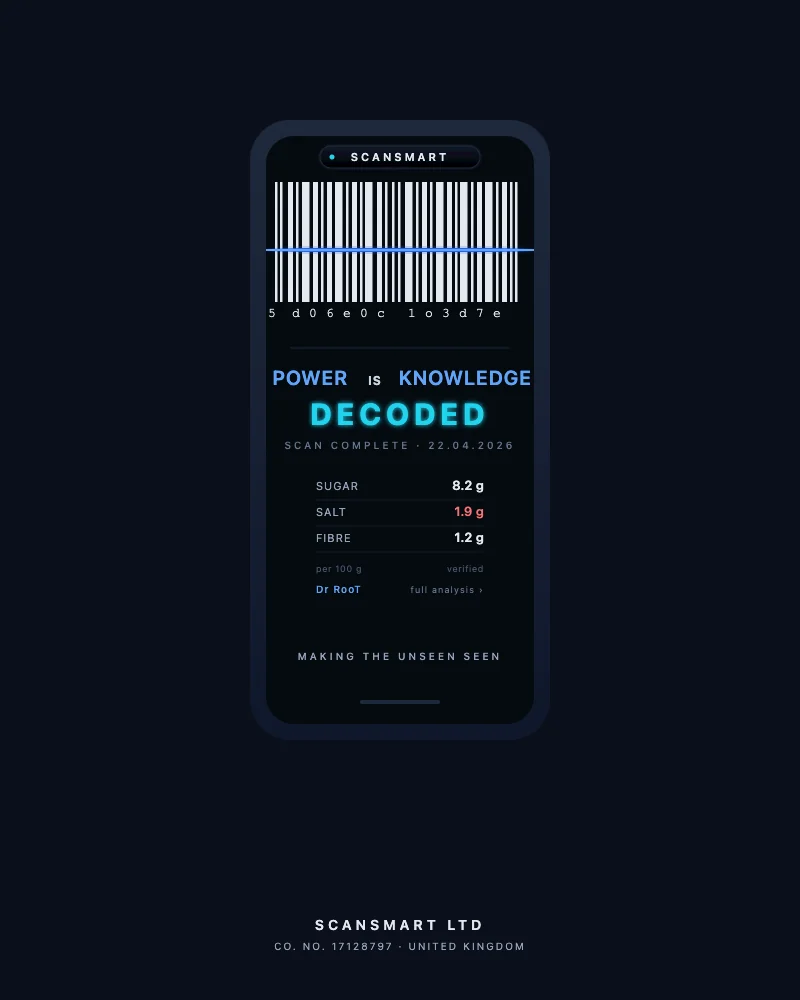
The tent, the data, and the six delivery systems.
SCANSMART is the platform infrastructure. The I500 is the data asset. CheckIT, the Weekly Supermarket Checkout, the Knowledge Library, the Partner programme, the Aisle Card NFC strategy, and the NHS HealthStore pathway are the six delivery systems through which the data reaches the world. Community-sourced. Institution-monetised.
Lead with the tent.
Most food-tech companies are products with a brand attached. SCANSMART is built the other way round — an infrastructure with products attached. The infrastructure is the tent. The data inside the tent is the I500. Everything else is how the I500 reaches the people, institutions, and contexts that need it.
This matters because it changes what we’re comparable to. SCANSMART isn’t a Yuka competitor. SCANSMART is a food-domain platform that combines what currently lives in five different categories of company: a consumer food scanner, an institutional B2B data product, a recurring publication, an evidence-led knowledge library, and an NHS clinical pathway. Nobody in food has all five behind one brand. We’re building it because the gap is real and the architecture is what closes it.
Six delivery systems across three tiers
- Tier 1 (institutional): the I500 enterprise data licence; the NHS HealthStore clinical pathway; the Partner programme for councils, schools, foundations
- Tier 2 (community): the I500 community-audit programme that builds the corpus, with shop-owner consent and trained local auditors
- Tier 3 (public): the KiP consumer scanner; the Weekly Supermarket Checkout, Decoded; the Knowledge Library; the I500 Shop Directory; KiP Stories — all free, all open, all reachable from this website
What we do not do
SCANSMART is not a medical device. We do not diagnose, prescribe, treat, or replace clinical advice. We are a food literacy and decision-support platform. CheckIT helps you read what’s in your shopping; it does not tell you what to do about it.
SCANSMART is not a paid-content gatekeeper for food data. The Weekly Supermarket Checkout, the Knowledge Library, the I500 Shop Directory, KiP Stories, and CheckIT are all free for everyone. Per our Belongs-to-Everyone Rule, the public-good substrate is genuinely public. Institutional revenue from the I500 enterprise licence and the Partner programme is what funds the public substrate without depending on permanent grant support.
SCANSMART does not sell user data, run advertising, or take ad revenue. The website never has and never will carry third-party advertising.
Built in South London
SCANSMART Ltd was incorporated in February 2026. Co. No. 17128797. Registered in England & Wales. The I500 community audit programme started in March 2026 in South London independent shops. The CheckIT Progressive Web App went live at app.scansmart.uk on 22 April 2026. The Decision Record (the central data corpus that powers everything else) went live on 29 April 2026. This website (v5.0 architecture) launches in May 2026.
Founder: Clive A Laws. Working with: a growing network of independent shop owners, community auditors, NHS clinical contacts, foundation funders, academic collaborators, and partner-borough commissioning officers. The goal isn’t to build a small company; it’s to build the infrastructure that helps a generation read what’s in their food, in plain language, where they actually shop, in the postcodes where the gap matters most.
How to engage
Depending on who you are:
- You want to scan your own shopping — open CheckIT at app.scansmart.uk
- You’re a retail intelligence buyer, FMCG manufacturer, or research organisation — the I500 page describes what we license and how to inquire
- You’re an NHS commissioner, GP network, school, council, community organisation, or foundation funder — the Partner programme page describes the five partner pathways and how to start a conversation
- You want to read what we publish — the Weekly Supermarket Checkout, Decoded updates Mondays; the Knowledge Library is the standing reference; the KiP Stories are real users telling their own decoding moments
- You want to support the work professionally — Subscriptions for journalists, researchers, dietitians, council policy officers (Subscription tier launches with v5.1 of the platform)
- You want to get in touch — contact form