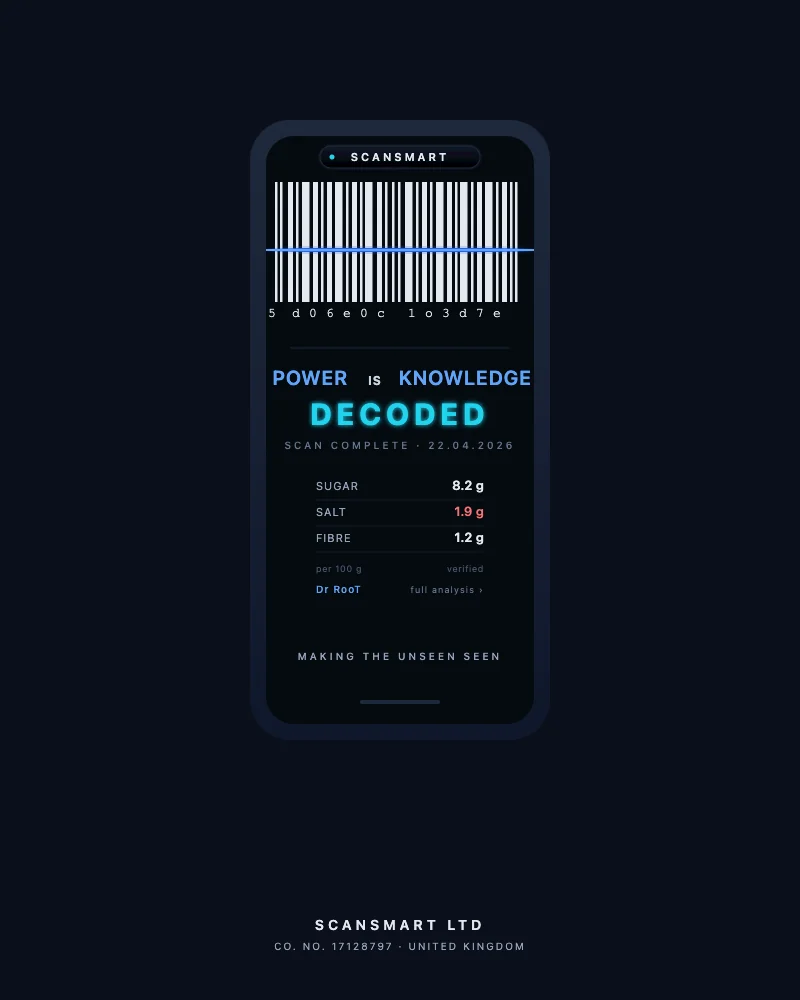
What SCANSMART is — and how CheckIT works.
SCANSMART is the platform behind a free phone scanner called CheckIT, a verified product database called the I500, a public Knowledge Library, and a professional terminal for analysts called FLT. The four products share one mission: make what is actually inside a barcoded product legible at the moment someone is deciding whether to buy it.
The trunk document. Read first. Every product on this site descends from this frame.
Scan a barcode. Read what is behind it.
You scan a barcode. CheckIT reads the label the way you would if you had time, training, and a magnifying glass — and tells you, in teaspoons and sachets, what is actually in the product in front of you. No 1–100 score. No proprietary index quietly folding a dozen judgement calls into one number. The units are ones you already know from school and the back of the cereal box: teaspoons of added sugar, sachets of salt, the traffic-light bands the NHS uses on the back of pack.
If you want a sharper read on a specific thing — sugar, salt, caffeine, saturated fat, ultra-processed-food markers, the family-shop view — you tell CheckIT what you are watching. The scanner calls these lifestyle preferences, not condition modes. A shopper watching their sugar may be diabetic; they may be the parent of a five-year-old; they may simply be the kind of buyer who reads the back of pack before the front. The preference is the preference; the scanner does not infer a condition from it, and does not store one.
Your scans live on your phone. What you have scanned is yours to see; nothing identifies you to anyone else. You can opt out of contributing to the aggregate view at any time, and opting out actually works.
Four surfaces. One infrastructure.
CheckIT is the free consumer scanner.
The I500 is the verified product database that feeds the scanner and underwrites everything else.
The Knowledge Library is the public educational shelf — decoder pages, evidence vaults, the SCANSMART Method, a weekly publication called The Weekly Supermarket Checkout. Free to anyone, read in any of an expanding set of languages. Patient, scaffolded, with sources named.
FLT — the Food Label Terminal is the keyboard-first professional surface for analysts at desks: NHS procurement officers, retail category managers, regulators, brand category teams, researchers, journalists. Seven panels, autocomplete, compare-mode, the dense-data read.
Three tiers. One architecture.
The free tier covers CheckIT and everything in the Knowledge Library. It is funded by the institutional tier; it is not crippled to drive upgrades; it is the food-literacy backbone. A household reading a label, a student reading a decoder page, a community broadcaster citing a Library entry — the free surfaces are theirs at no cost.
The consumer paid tier is the CheckIT Family Plan: six profiles in a household, Scan History, basket retention, premium content access. The household-level analytical view, deepened.
The institutional paid tier is institutional licensing — the I500 verified dataset and FLT terminal access for NHS, academic, retail-intelligence, and policy buyers. A formal partner programme (commissioner briefs, sector reports, commissioned audits) is a future layer that opens once there is a proven pilot behind it. Pricing is calibrated against existing institutional benchmarks rather than consumer-app norms.
Six commitments that do not bend.
No advertising. No manufacturer or retailer sponsorship. No paid promotional placements on any surface, free or paid, ever.
No tracking. Per-individual scan data stays on the user's device. The B2B product is aggregate non-personal data. Opt-out is persistent and architectural.
No freemium cripple. The free tier is genuinely useful. Paid tiers add features; they do not remove them.
No medical claims. SCANSMART is a food literacy and decision-support platform. It is not a medical device and does not provide medical advice.
No false clarity. Citations carry their actual claim shape — associated with, linked to, observed in — never causes, cures, or treats where the evidence does not support those words.
No extraction. The structural critique names the manufacturer's role honestly. Industry-funded nutrition studies favour sponsor outcomes at a peer-reviewed odds ratio of 7.61. The gap between what a label says and what a label means did not appear by accident; it was engineered. The critique sharpens the manufacturer's role and protects the shopkeepers and shoppers downstream of those decisions.
A seventh commitment, banked alongside the original six: SCANSMART may sponsor community media, schools programmes, and public-engagement infrastructure outbound. SCANSMART may never accept inbound sponsorship into any product surface. The two patterns are not symmetrical.
This is the editorial-integrity moat. A competitor that accepts manufacturer money is structurally compromised against the same peer-reviewed evidence base SCANSMART cites. The moat is not a slogan; it is what makes the data trustworthy.
Sixty years. Two cities. Two generations.
SCANSMART is the third generation of a family project in Brixton and Toronto that has spent sixty years making invisible people legible to systems that were not built to see them. Courtney Laws OBE ran the Brixton Neighbourhood Community Association from 1966 to 1996. Dudley Laws co-founded the Black Action Defence Committee in Toronto in 1988. The work has carried forward into a two-city, two-generation operating team of six. The founder is Clive Laws. The Leeds operational pair, the East London CheckIT lead, the SW9 community-trust anchor in the Lambeth pilot borough, and the Toronto node lead each hold their role because of who they are in the lineage and where they actually live.
The infrastructure is being built to outlast its founders.
Pick your door.
If you want to scan your own shopping, open CheckIT at app.scansmart.uk or install it on your phone.
If you want to read what we publish, the Weekly Supermarket Checkout, Decoded updates Mondays; the Knowledge Library is the standing reference.
If you are a retail intelligence buyer, FMCG manufacturer, academic researcher, or policy organisation, the I500 page describes what is licensed and the FLT page is the professional terminal.
If you are an NHS commissioner, ICB, GP network, school, council, community organisation, or foundation funder, our institutional enquiries page is the place to start.
If you want to get in touch, the contact form is open.
The Project v0.1 · banked 23 May 2026 · SCANSMART is a food literacy and decision-support platform; not a medical device.